|
Strength & Conditioning Class Purpose: Educate dog owners on safe and effective strengthening techniques to optimize
health and prevent injuries. Exercises: Core Stabilization, Eccentric
and Concentric Spinal Extension, Eccentric and Concentric Limb Flexion and Extension, Coordination, Proprioceptive Awareness,
Endurance. Methods: All strengthening exercises are taught slowly
with control allowing all levels of dogs to participate. Conditioning exercises will increase heart rate and teach owners
how to put fun into fitness with their pets. Contraindications:
Acute injuries, ligament spraings/strains/tears, function limiting arthritis, unstable cardiac conditions, behavioral issues.
Stretch the Dog! Class Based on the patent-pending
Foster Canine Stretch Method, this class with each dog owners how to safely and effectively stretch their dogs to optimize
movement and prevent injuries. The Five-Step Stretching Technique 1. Warm-up: In order for a stretch to be safe and effective the tissues must be warm (1,2). Warm-up is recommended
for all dogs but is required for geriatric animals due to tissue frailty and the increased likelihood of injuries (3).
2. Relaxation: The definition of a passive stretch is lengthening of muscle and connective tissues
(4). In order to ensure relaxation of muscle tissue in dogs, they must be lying down prior to beginning a stretch.
3. Joint
Stabilization: To keep the muscle tissues relaxed during
a stretch, the joint must be stabilized. Stabilization is defined as manually supporting the joint which prevents reflex responses
and allows the muscle to remain relaxed throughout the stretch (5,6).
4. Straight Plane Movement: To ensure the correct muscles are being stretched and to prevent incorrectly stretching supporting
ligamentous structures (especially in the stifle joint), the limb is lifted into a straight plane in relation to the joint
is being stretched.
5. Stretch: The stretch is held
for at least 30 seconds.
Joint Stabilization: 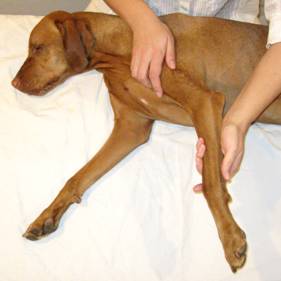
Straight Plane: 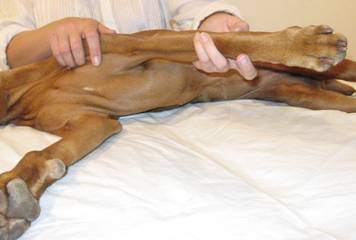
Stretch: 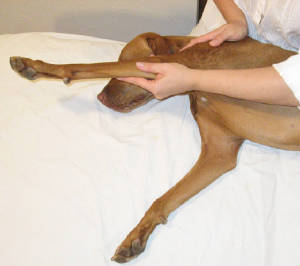
Resources
1) Effect of Temperature on Muscle Pitman,
M.I., and Peterson, Lars, 1989, William & Wilkins (ed.), Basic Biomechanics of the Musculoskeletal System, 2nd
Edition, Basic Biomechanics of Skeletal Muscle, Chapter 5: 102.
2) Effects of Temperature on Cartilage/Joints Mow, V.C., Proctor, C.S., Kelly, M.A., 1989, William & Wilkins (ed.), Basic Biomechanics
of the Musculoskeletal System, 2nd Edition, Biomechanics of Articular Cartilage, Chapter 2: 47-54.
3) Effects of Aging on Muscle Tissue Carlstedt, C.A., and Nordin, M, 1989, William
& Wilkins (ed.), Basic Biomechanics of the Musculoskeletal System, 2nd Edition, Biomechanics of
Tendons and Ligaments, Chapter 3: 68.
4) Definition of Stretching O’Sullivan, S. B., 1888, F.A Davis (ed.), Physical Rehabilitation Assessment
and Treatment, 3rd Ed, Strategies to Improve Motor Control and Learning, Chapter 13: 231.
5) Muscle Control Loeb,
G.E. 1984. The control and responses of mammalian muscle spindles during normally executed motor tasks. Exer. Sport Sci.
Rev. 12:157-204
6) Muscle Control Kandel, E.R., Schwartz, J.H., and Jessell, T.M, 1991, Fusimotor output can be adjusted
independently of motor output. In Appleton & Lange (ed.), Principles of Neural Science, 3rd Ed., Chapter 37:
573-574.
|

